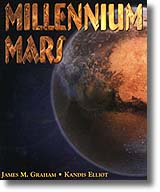
he Millennium Mars Calendar is a truly Martian
calendar, with a scheme of months and days that track Mars' journey
around the sun. The system was developed by biologist Dr. James Graham
for future Martian colonists who would need, he claims, "to order
their lives according to Martian days and seasons." Since Mars orbits
farther from the sun than the Earth does, it takes longer to make a full
revolution--about 687 Earth days; thus its seasons are almost twice as
long as those on Earth.
he Millennium Mars Calendar is a truly Martian
calendar, with a scheme of months and days that track Mars' journey
around the sun. The system was developed by biologist Dr. James Graham
for future Martian colonists who would need, he claims, "to order
their lives according to Martian days and seasons." Since Mars orbits
farther from the sun than the Earth does, it takes longer to make a full
revolution--about 687 Earth days; thus its seasons are almost twice as
long as those on Earth.

Graham's system divides the Martian year into 20 months of 33 or 34
days each. The months are named for Greek gods and goddesses. The
Martian week still has seven days, but the days are renamed to
correspond to the planets (Solday, Mercuryday, etc., ending with
Saturnday.) This particular calendar begins on the first day of the
month of Hestia, Mars year 12, which corresponds to Dec. 20, 1999 (the
years start with the landing of Viking 1 in 1976). It ends one Martian
year and 2 months later, on Asclepius 33, year 13, or Feb. 1, 2002.
This odd span was chosen to cover the Earth years before and after the
millennium (January 1, 2001) and to include the more popular 1999 to
2000 turnover. Earth dates, by the way, are superimposed on the
calendar.
Additionally, the calendar is a miniature textbook on Mars.
Introductory pages explain the date system and then present some
background on the cold little planet, as well as its climate and
conditions. An overview of how Mars might be terraformed follows. The
writing is marginally technical but still accessible to anyone with an
interest in science. Each month presents a mural and a short article on
various subjects, including Martian geology, weather, ice caps, further
details on terraforming, the possibility of early Martian life, and much
more.
Informative and artistic
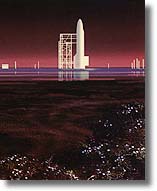
The written material of the Millennium Mars Calendar is
detailed yet readable, and it is complemented by Kandis Elliot's
marvelous illustrations, which combine computer rendering and electronic
airbrush work. Most of the pictures depict what Mars might look like
from the surface--the color of the sky at dusk, the windswept desert
dunes, and the glittering ice. Some show the Martian landscape at
different stages of terraforming. For example, there's an image of a
valley system filled with water, with gliders drifting over in
V-formation. It's very inspiring. The articles and illustrations are
so well done, complete with inset NASA photos and maps, that it feels
like they could come from an issue of Mars Geographic.
The calendar itself also makes an excellent educational tool,
graphically showing Mars' long seasons and year. January 2001, for
instance, begins in early Poseidon 13. Turn ahead two months to
Demeter, and there's April already! As a working calendar, though, it's
not too useful, at least not for groundhogs on Earth. Because the
Martian day is about 40 minutes longer than Earth's, the days drift and
overlap in strange ways, making it tough to do any Earthly planning.
And would Martian colonists really break utterly from the Earth
calendar? Perhaps, but it would make communication and coordination
with Earth difficult.
Of course, that's not the point. This calendar is an informative and
beautiful resource for Earthlings here and now, and should fascinate
both children and adults.