
Posted at 07:04 a.m. PDT;
Wednesday, April 21, 1999
Martian time? First extraterrestrial sundial
to arrive on red planet in 2002
by Eric Sorensen
Seattle Times staff reporter 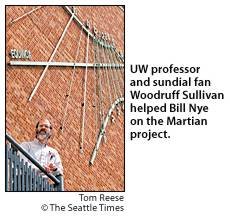
Finally, an answer to the perennial question: What time is it on Mars?
In three years, surfers of the World Wide Web will be able to find out
by looking at images of a sundial beamed from NASA's 2001 Mars Surveyor.
This raises another question: Who on Earth cooked up this idea?
That would be Bill Nye, with an assist from the University of
Washington, Cornell University and the Planetary Society.
The first extraterrestrial sundial will head for Mars in April 2001 as
part of the Athena Precursor Experiment, or APEX, which will study the
geology and chemistry of Mars and eventually bring back rock samples. It
will land in January 2002.
Nye, host of KCTS-TV's offbeat science program, "Bill Nye the Science
Guy," got the idea after noticing a small square and post used to
calibrate the Mars Surveyor lander's panoramic camera and wondering
whether it might be turned into a sundial. Far-fetched to most, the idea
was obvious to Nye, who has also imagined turning the Space Needle into a
sundial, with its faceplate running up Queen Anne Hill.
"I want everyone in the world to share in this," Nye said yesterday
from Pittsburgh while on his way to this morning's announcement of the
project from Cornell, his alma mater. "That's my goal - and to ponder our
place in the universe. There's that. No big deal."
Working out the right design
Other scientists had thought of turning the lander's calibration target
into a sundial but had failed to come up with a design that would work on
Mars. For that, Nye turned to Woodruff Sullivan, UW professor of astronomy
and designer of the sundial on the face of the university's
Physics-Astronomy Building.
Sullivan acknowledges the Martian sundial has no immediate practical
value but expects it will help schoolchildren learn how we chart time and
the origin of notions like the day and the year.
"It does have the insidious effect of making you rethink some things,"
he said. "But as far as what's the use? It's an intellectual idea. It's
not measuring how much calcium there is in the rocks on Mars."
The project will also further Sullivan's personal agenda of making
Seattle "the sundial capital of North America."
"I love the irony of it," he said, alluding to the city's relative lack
of sun to be dialed. "We appreciate the sun here that much more."
A 5,000-year-old technology
The Mars sundial will certainly be among the solar system's most
far-reaching marriages of high and low technology.
Sundials go back more than 5,000 years, starting with the gnomon, which
was little more than a stick that cast a shadow to track the passage of
time. The analog clock is a direct ancestor, with its hands mimicking the
clockwise motion of a shadow in the Northern Hemisphere.
For all its simplicity, the Mars sundial took eight months of work and
e-mail by eight people, including three Cornell planetary scientists and
two artists. The group had to consider that Mars has a tilt of 25 degrees
on its axis, unlike Earth's 23.5 degrees, and that a day on Mars is about
37 minutes longer than on Earth.
Because the sundial will be placed somewhere along the Martian equator,
the sun will be north of the Martian sundial part of the year and south of
it the rest of the year. Sullivan is planning to celebrate a day in early
2002 when, at noon on Mars, the sun will be directly above the sundial,
casting no shadow at all.
Schoolchildren contributed art
The final product is a hollow aluminum post affixed to a 3- by 3-inch
platform. It weighs 2 ounces and cost $20,000 to build three, one bound
for Mars and two spares.
In keeping with the Renaissance tradition of putting mottos on
sundials, it says, "Mars 2002 - Two Worlds, One Sun." Along the edges of
the platform are the words for Mars in 24 different languages, including
the language of the ancient Mayan culture, which was more astronomically
advanced than Europe.
An accompanying plaque offers something of a "Hail alien well met"
message to potential passers-by, along with stick figures drawn by
schoolchildren from across the country.
The sundial's design will not be complete until after the lander
touches down and Sullivan can determine its exact latitude and how level
it is sitting. He can then make an overlay to go over the Web image and
explain things like the current time and, depending on what kind of
calendar is devised for it, the date.
Copyright © 1999
Seattle Times Company
| 