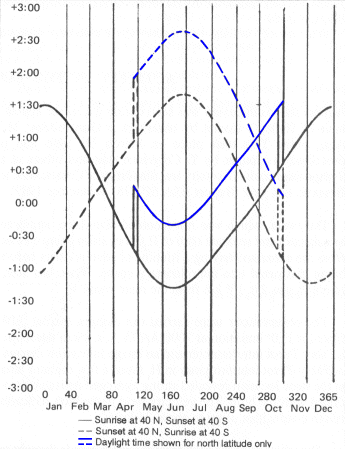
Figure A3-6: Variation in Times of Sunrise and Sunset, 40 Degrees Latitude, Earth
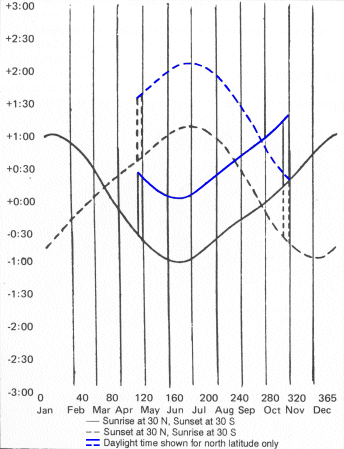
The intent of the civil use of daylight time on Earth is to make the hour of sunrise more stable throughout the year. For instance, Figure A3-5 depicts how the time of sunrise changes throughout the year on Earth at 30° north latitude, including the seasonal adjustment of daylight time as observed in the USA. Of the contiguous states, only those on the coast of the Gulf of Mexico are this close to the equator; yet at this latitude, even with daylight time helping to stabilize the time of sunrise, it may occur as early as 05:18 in the last week of April and as late as 07:14 in the last week of October - a fluctuation of nearly two hours. Figure A3-6 shows the variation in the time of sunrise on the 40th parallel, a latitude more representative of the USA. Here the Sun may rise as early as 05:02 and as late as 07:28, a difference of nearly two and a half hours. Bearing in mind that some areas of the contiguous USA are nearly as far north as 50°, and that the 50th parallel cuts right through Western Europe, where a similar daylight time scheme is used, a variation of three hours serves as a reasonable benchmark for the maximum desirable change in the hour of sunrise.
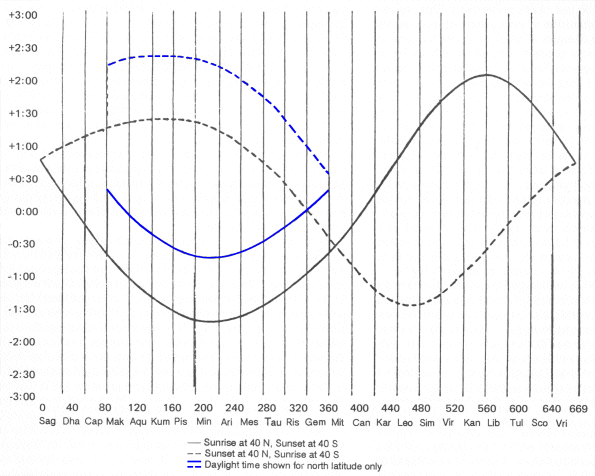
In the case of Mars, Figure A3-4 shows the varying times of sunrise and sunset at 40° north and south latitude. At this latitude in the southern hemisphere, sunrise fluctuates from 04:25 on Leo 17 (Sol 463) to 07:19 on Kumbha 17 (Sol 154), a change of 2h 54m, and sunset varies from 16:10 on Mina 9 (Sol 204) to 20:01 on Kanya 28 (Sol 557), a difference of 3h 51m. As in the example of the tropic circles of Mars, the total change in time of sunrise and sunset are reversed at 40° north latitude, where dawn is at its earliest at 04:10 on 9 Mina and at its latest at 08:01 on Kanya 28, a difference of nearly four hours, and dusk varies from as early as 16:25 on Leo 17 to as late as 19:19 on Kumbha 17.
Martian demographics of the 21st century and beyond is difficult to predict, but even if there is a significant percentage of the population living as far south as the 40th parallel, a fluctuation in the time of sunrise throughout the year of up to 2h 54m will probably be acceptable, as against inducing the complication of civil daylight time to reduce this variation.
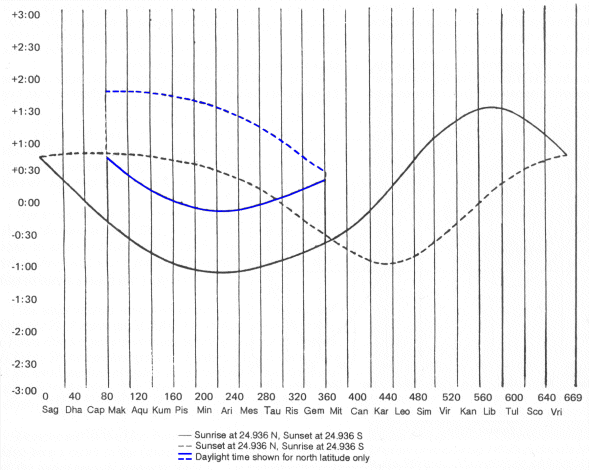
Between Tropicus Piscium and 40° north latitude, however, the total annual change in the hour of dawn varies between 2h 35m and 3h 51m, which suggests that daylight time might be legislated for these latitudes if there is a sizable population located near or north of the 40th parallel. On the other hand, if the significant Martian population centres are confined to well south of the 40th northern parallel, daylight time might be dispensed with altogether. As shown in Figure A3-3, were daylight time to be instituted on and north of Tropicus Piscium from Makara 1 (Sol 85) to Gemini 28 (Sol 362), the earliest dawn on the northern tropic circle would occur at 05:17 on Gemini 28, limiting the total annual fluctuation to 2h 9m on Tropicus Piscium. Similarly, Figure A3-4 shows that the earliest sunrise on the 40th parallel of the northern hemisphere would take place on Makara 1 at 05:11, limiting the total annual variation to 2h 52m at this latitude. The institution of daylight time north of Tropicus Piscium from Makara through Gemini thus brings the annual change in the hour of sunrise to about the same value as that experienced below Tropicus Virginis.